
Best Water Damage Restoration Companies Near You
You didn’t plan for this. Nobody does. One minute you’re walking through your home on a Tuesday evening, and the next you’re standing in a puddle, staring at a wet ceiling, your brain cycling between “where is the water shutoff again?” and “who do I even call right now?” That moment, the one where you grab your phone and search “what are the best water damage restoration companies near me”, is one of the most stressful searches a homeowner ever makes. You’re almost always making it under pressure, sleep-deprived, or both.
At Taylor Home Improvement, we’ve helped homeowners work through the aftermath of numerous water damage situations across Noblesville and the greater Indianapolis area. We’ve also noticed something that most homeowners only realize after the fact: a meaningful share of these situations started outside the home, not inside. A failing roof. Gutters that hadn’t drained properly in two seasons. Siding that had been letting moisture into the wall cavity for months. We’ll come back to that. But first, let’s make sure you know exactly how to find the right restoration crew, vet them quickly, and protect yourself through the whole process.
What are the best water damage restoration companies near me, and how do you tell them apart?
When you’re panicking, the temptation is to call the first number in the search results and hand the situation to someone, anyone, who sounds confident. That instinct is understandable. It can also be expensive. Water damage restoration licensing requirements vary significantly by state, and the quality gap between legitimate water mitigation specialists and poorly trained operators can be wide. Knowing what to verify before you commit takes about five minutes and can save you thousands.
The IICRC certification you need to ask about first
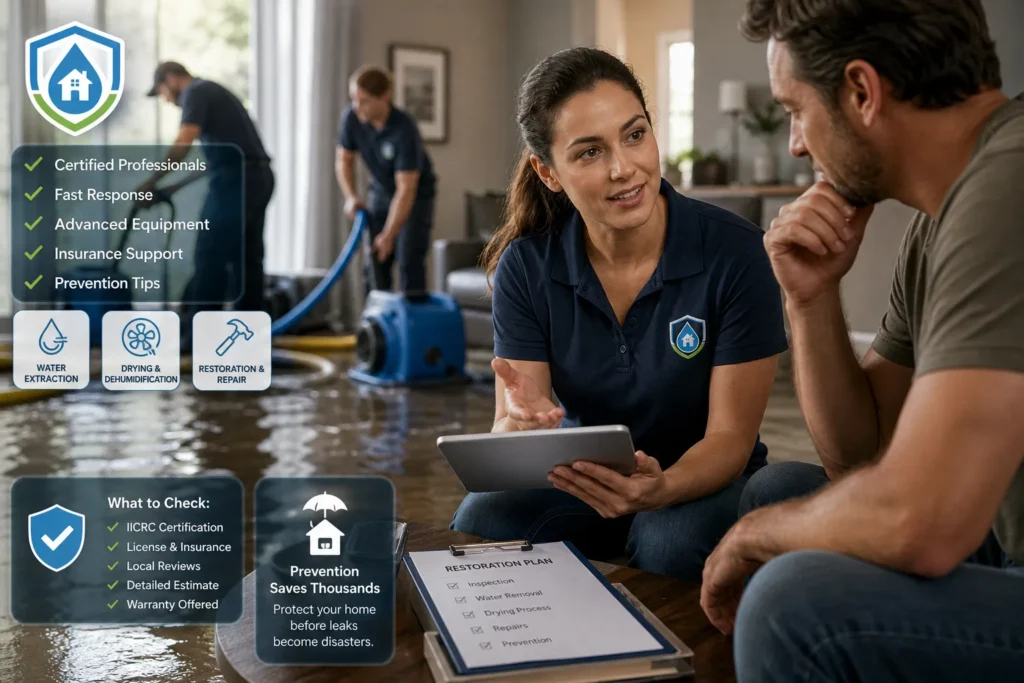
The Institute of Inspection, Cleaning and Restoration Certification, the IICRC, sets the recognized industry standard for water damage remediation. The three certifications that matter most for a residential water loss are WRT (Water Damage Restoration Technician), ASD (Applied Structural Drying), and AMRT (Applied Microbial Remediation Technician). WRT is the baseline credential; ASD is the recommended certification for structural drying work; AMRT becomes relevant any time mold or sewage contamination is involved.
A certified firm employs at least one IICRC-certified technician, that’s the company-level standard. Ask specifically which certifications are held by the actual crew coming to your home, not just a manager at headquarters. You can verify any technician’s certification number directly through the IICRC Global Locator at iicrc.org. If a company resists that request, treat it as a signal.
Licensing and insurance checks that protect your wallet
Beyond certifications, verify three things before anyone steps through your door:
- Confirm the company holds an active state contractor license that matches their business name exactly.
- Ask for a current certificate of general liability insurance.
- Confirm they carry workers’ compensation coverage if they have employees on staff.
That last point is not a formality. If a worker is injured on your property and the company lacks workers’ comp, your homeowners policy could potentially be exposed to that liability, though outcomes vary by policy and state, so confirm your specific coverage with your insurer. Legitimate local water damage cleanup companies carry all three without hesitation. Any company that hedges on producing these documents is not one you want inside your home during a crisis.
Local track record vs. national franchise names
Some national flood restoration brands, SERVPRO being a well-documented example, advertise structured response commitments: a 1-hour contact, 4-hour on-site, 8-hour briefing guideline at the franchise level. Those are meaningful standards. But franchise quality varies significantly by location, and a national brand name doesn’t guarantee that your specific local franchise lives up to those commitments.
What matters more than brand recognition is verifiable local performance: documented years of service in your area, a physical local presence, and a pattern of recent reviews that reflect real work. A well-reviewed local operator can outperform a franchise in many cases, weigh review detail, recency, and documented local experience rather than logo recognition alone. Judge the location, not just the brand.
How to vet water damage restoration companies near me: questions worth asking
You don’t need a long script. A few direct questions will tell you most of what you need to know about any emergency water damage repair company before you commit.
What their emergency response window really looks like
The industry benchmark for on-site arrival is 1 to 4 hours, and that window matters because the first 24 to 48 hours are critical for preventing secondary damage, mold growth, structural deterioration, and material absorption that turns a manageable loss into a major one. Ask directly: “What is your guaranteed arrival time for emergency calls in my zip code?” If the answer is vague, that’s useful information in itself.
How they document damage for your insurance claim
A restoration company worth hiring will document everything your adjuster needs: moisture readings, photo and video evidence, mitigation logs covering extraction and drying, an itemized inventory of damaged materials, and a written scope-of-work report. Ask whether they communicate directly with your insurance adjuster or whether that coordination falls on you. The best 24/7 water damage contractors treat claim documentation as part of their core service, not an afterthought. If a company shows up with a truck but no documentation process, you’ll be managing the paperwork alone during one of the most stressful weeks of your year.
Reading reviews the right way without getting fooled
A star rating is a starting point, not a conclusion. Most homeowners glance at the number, see 4.7, and move on. That approach misses the actual signal buried in the reviews themselves.
Where to look beyond the Google rating
Cross-reference at least three platforms: BBB, Yelp or Angi, and NextDoor or a local community group. On the BBB profile, look at the complaint history and resolution patterns rather than the letter grade. A company with an A rating and unresolved complaints tells a very different story than one with a B+ and a documented pattern of making things right. A company with 4.2 stars that responds professionally to every criticism is often more trustworthy than one sitting at 4.9 with no complaints and a suspiciously short review history.
Red flags hiding in positive reviews, and why response patterns matter
Watch for reviews that sound templated, a cluster of five-star reviews appearing suddenly after a long gap, or glowing feedback that never mentions a specific detail about the work done. These patterns suggest review manipulation rather than genuine customer experience. Pay equal attention to how a company responds to negative reviews. A defensive or dismissive reply to a homeowner who needed water damage remediation and had a bad experience reveals exactly how that company operates under pressure, which is precisely when you’ll be depending on them.
Reviews from the past 12 months carry far more weight than older ones. A strong reputation from 2022 doesn’t tell you much about the crew that will show up in 2026.
What water damage restoration actually costs and how your insurance fits in
Here are realistic 2026 pricing ranges for residential water damage restoration, broken down by scope, so you can evaluate quotes with confidence.
Realistic cost ranges based on how serious the damage is
Minor single-room clean-water losses typically run $500 to $1,500. Moderate single-room damage lands around $1,500 to $3,000. Major multi-room losses climb to $3,000 to $7,000, and severe losses requiring structural reconstruction often exceed $7,000. Water extraction alone generally costs $300 to $3,000 depending on volume, with structural drying adding another $500 to $5,000 on top. A bid that’s dramatically lower than the range for your damage category is worth scrutinizing just as much as one that’s dramatically higher.
What your homeowners policy covers and where it draws the line
Standard homeowners insurance covers sudden and accidental water damage tied to a covered peril: a burst pipe, a broken appliance hose, an accidental overflow, or wind-driven rain from a covered storm event. It does not cover flooding from groundwater, gradual seepage, sewer backup without a specific rider, or damage that resulted from deferred maintenance. Your insurer will effectively ask two questions: what caused the water, and was the damage sudden or ongoing? Understanding that framing before you file helps you document correctly from the first hour.
What your restoration company should hand your adjuster
Reputable water damage remediation companies provide everything your adjuster needs in one package: thorough moisture readings, photo and video documentation, extraction and drying logs, an itemized inventory of damaged materials, and a written scope-of-work report. The standard claim sequence is to contact your insurer promptly, stop the water source if possible, document everything before cleanup begins, make only temporary repairs to prevent further damage, and wait for adjuster approval before starting permanent repairs. A good restoration company walks you through this sequence rather than leaving you to figure it out alone.
Why your exterior may be the real reason this keeps happening
This is the part most homeowners miss entirely, and it’s the part we care most about at Taylor Home Improvement. While internal plumbing failures are the most common single cause of residential water damage, exterior-envelope failures are a significant and often overlooked contributor that many homeowners never address.
How failing gutters, worn roofs, and compromised siding invite water inside
Clogged or sagging gutters allow water to overflow directly against the foundation and siding. Aging shingles with missing granules or cracked flashing let water penetrate the roof deck. Worn or improperly installed siding creates gaps where moisture infiltrates wall cavities over months before any visible damage appears inside. These aren’t dramatic, sudden failures, they’re gradual ones that quietly accumulate until a homeowner is searching for emergency help at 11pm, convinced it’s a plumbing problem when the actual source has been the roofline for two winters.
How preventative exterior upgrades eliminate the source of the problem
Consider the math. A seamless gutter installation or a roof replacement can cost a fraction of a typical $4,000 to $7,000 water restoration bill, and that’s before factoring in mold remediation, your insurance deductible, and the week of disruption that comes with interior water damage. Restoration addresses the result. Preventative exterior work addresses the cause.
This is where Taylor Home Improvement comes in. As a family-owned, GAF Master Elite certified contractor serving Noblesville and the greater Indianapolis area, we specialize in the exterior systems that most commonly fail and lead to interior water damage: roofing, seamless gutters, and James Hardie fiber cement siding. GAF Master Elite is one of the highest certifications available from GAF, held by a very small percentage of contractors in Indiana, which means we can offer extended limited lifetime warranties that most local competitors simply can’t match. A free exterior inspection estimate costs you nothing and can prevent the call no homeowner ever wants to make.
What to do right now if water has already entered your home
If you’re reading this in the middle of a water event, here’s your immediate action list.
Immediate steps to limit damage before the restoration crew arrives
- Shut off the water source if this is a plumbing failure.
- Cut power to affected areas if there’s any risk of electrical contact with standing water.
- Move valuables, furniture, and documents out of the wet zone.
- Use towels or buckets to redirect flow, but do not use a standard household vacuum on standing water.
If outdoor humidity is lower than indoor, open windows to begin airflow. These steps won’t replace professional water extraction services, but they meaningfully limit secondary damage while you wait for the crew to arrive.
How to document everything before cleanup starts
Before anything is touched or moved, photograph and video every affected room, every visible water source, and every damaged item. Note the time you discovered the damage, the apparent source, and any pre-existing conditions you’re aware of. Save all receipts for emergency materials and any temporary repairs you make. This documentation becomes the foundation of your insurance claim and gives your restoration company a clean, accurate starting point for their own assessment. Starting this process early costs nothing and protects everything.
You've got this, and you've got options
Water damage is stressful, and there’s no way around that. But you now have a clear framework for finding and vetting the right restoration crew, asking the questions that reveal whether a company is truly reliable, and navigating the insurance process with confidence rather than guesswork. If you’re still wondering what are the best water damage restoration companies near me, start with IICRC credentials, verified insurance, recent local reviews, and a clear documentation process, those four filters will carry you further than any brand name alone.
Once the restoration is behind you, take one more step. Walk around the outside of your home and ask honestly: what let the water in? If the answer involves aging gutters, a roof that’s seen better decades, or siding that’s starting to show its age, that’s a conversation worth having before the next storm season. Reach out to Taylor Home Improvement for a free estimate. We’ll tell you exactly what we see, and exactly what it would take to close that door for good.
FAQ's
How do I know if I need storm damage roof repair?
After a storm, look for missing or curled shingles, granules collecting in gutters, dents from hail, or water stains on ceilings. Even minor damage can worsen over time, so it’s best to schedule an inspection soon after severe weather rather than waiting for leaks to appear.
Does renters insurance cover basement flooding?
Typically, standard renters insurance covers your personal belongings if flooding results from a covered peril, like a burst pipe, but it usually does not cover flooding caused by natural disasters or groundwater seepage. For that, tenants often need a separate flood insurance policy. Always check your specific policy details or ask your insurer directly.
What does storm damage cleanup usually involve?
Storm damage cleanup often includes removing debris, extracting standing water, drying out affected areas to prevent mold, tarping damaged roofs, and assessing structural safety. Professional cleanup crews can also help document damage for insurance claims.
How soon after a storm should I schedule roof repairs?
It’s best to arrange an inspection within a few days of the storm. Prompt storm damage roof repair helps prevent secondary issues like water intrusion, mold growth, or further structural damage, and can also strengthen your insurance claim.
Who is responsible for storm damage cleanup and repairs in a rental property?
Generally, landlords are responsible for repairing structural damage, including roof repairs, while tenants are responsible for their personal belongings. This is another reason understanding whether renters insurance covers basement flooding matters, since it affects what you can claim versus what falls on your landlord.