
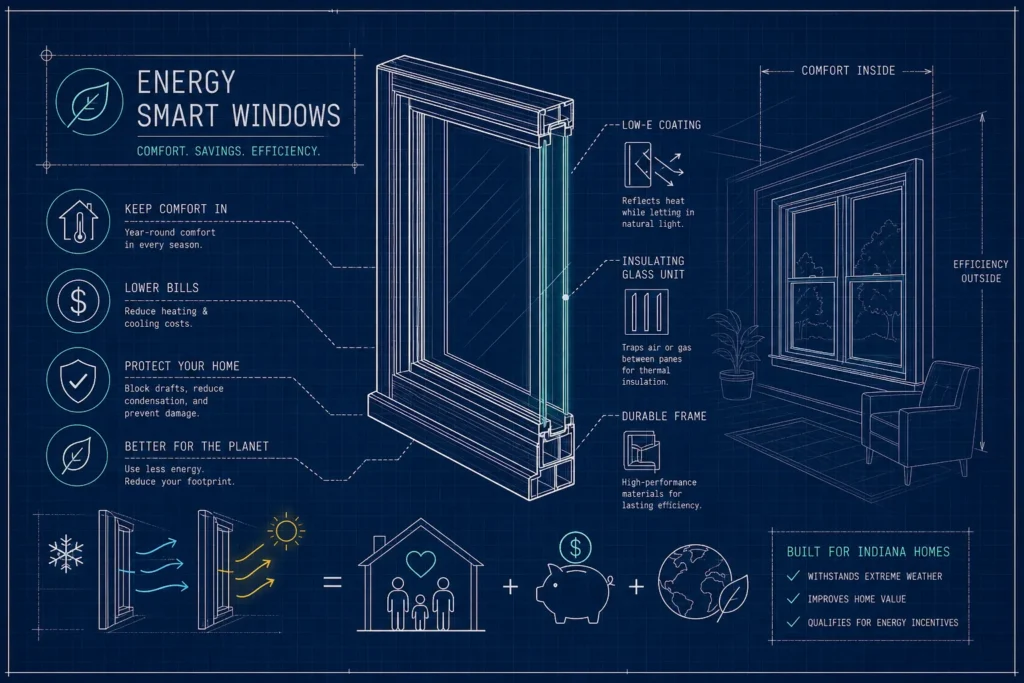
Energy-Efficient Windows for Indiana Homes: What to Know
Picture this: it’s a January evening in Noblesville, and you’re standing near a window in your living room. You can feel the cold radiating off the glass before you even touch it. The thermostat is set to 70, but the furnace won’t quit. Energy efficient windows Indiana homeowners choose are one of the most impactful upgrades you can make to your home, and at Taylor Home Improvement, we hear the same three questions on nearly every estimate call: which ratings actually matter, what does the project cost, and how do you find someone qualified to install them correctly?
This guide answers all three. It’s built specifically for Indiana’s climate, not recycled from a national overview written for a homeowner in Phoenix or Portland. By the end, you’ll know exactly what to look for on a window label, what to budget, where to find rebate dollars, and how to choose an installer you can trust.
Why Indiana's Climate Makes Window Efficiency a Real Priority
The heating burden Hoosier homeowners carry
Indiana winters are no joke. Average January lows in the northern part of the state regularly drop into the single digits, and even central Indiana sees extended stretches below freezing. Summers bring high humidity and heat that drives air conditioning demand well into September. This is a two-season energy problem, not just a seasonal inconvenience. Indiana has substantial winter heating demand, and windows are one of the primary contributors to heat loss in older residential construction.
What aging or single-pane windows actually cost you
Heat moves through a poorly rated window in three ways: conduction through the glass, air infiltration around the frame, and radiant heat loss on cold nights when your warm interior radiates toward the cold exterior pane. Single-pane windows can account for 25 to 30 percent of total heating and cooling energy loss in a home. Indiana’s freeze-thaw cycles compound the problem by working gaps open in aging frames and sealants over time, making older windows progressively leakier each winter. That’s money your furnace is burning to heat the outdoors.
Energy Efficient Windows Indiana: Reading the Ratings That Matter
U-factor and SHGC: the two numbers worth knowing
Every certified window carries two key ratings on its NFRC label. The U-factor measures how quickly heat transfers through the window. Lower is better, and you want the whole-window U-factor, not the center-of-glass number, which is always more flattering. Solar Heat Gain Coefficient (SHGC) measures how much solar heat passes through the glass. A lower number blocks more heat, while a higher number admits more, which can be useful in heating-dominant climates.
Indiana falls statewide under ENERGY STAR’s North-Central climate zone. The current certification threshold requires a whole-window U-factor of 0.25 or lower and an SHGC of 0.40 or lower. For most Indiana homes, a practical target is U-factor 0.22 to 0.25 and SHGC around 0.35 to 0.40, in line with ENERGY STAR North-Central zone guidance. These are ENERGY STAR certification standards, not Indiana building code minimums. The 2020 Indiana Residential Code sets a maximum U-factor of 0.32 for Zone 4A (southern Indiana) and 0.30 for Zone 5A (central and northern Indiana), with no mandatory SHGC requirement under the state code. ENERGY STAR is the higher, more meaningful bar to meet.
Double-pane vs. triple-pane: when the upgrade pays off
Triple-pane windows sound like the obvious premium choice, but the math tells a more nuanced story. A well-specified double-pane window with low-E coatings and argon gas fill can hit a U-factor of 0.25 or better at a significantly lower price point than triple-pane. Triple-pane typically adds only about 5 to 10 percent in additional window-related energy savings and adds $150 to $400 per window to the project cost.
Triple-pane makes the most sense in homes with unusually high heating loads, severe and persistent drafts, or a specific need to reduce exterior noise. For the majority of Indiana homeowners, a high-performance double-pane unit is the smarter value. Spend the savings on proper air sealing and installation quality, and you’ll come out ahead.
Costs and Rebates for Energy Efficient Windows in Indiana
Realistic cost ranges for an Indiana project in 2026
Standard vinyl insert replacement windows installed in Indiana run approximately $550 to $1,050 per window, with a practical average landing near $800 to $925 for most residential projects. A 10-window home typically runs $8,000 to $10,000; a 15-window project commonly falls in the $12,000 to $14,000 range. Full-frame replacements, fiberglass frames, bay or bow configurations, or installations on upper floors with difficult access push costs toward $1,200 to $2,000 per window.
Get at least three itemized quotes before signing anything. The word “replacement” means different things to different contractors: make sure each quote specifies whether the price includes full-frame work, interior and exterior trim, old window disposal, and permits. A quote that omits those line items will look attractive and then surprise you mid-project.
The energy savings Indiana homeowners can realistically expect
ENERGY STAR modeling for homes in comparable northern climate zones projects annual savings of $300 to $570 for homeowners replacing single-pane windows throughout the house. A conservative planning estimate for most Indiana homes is $200 to $500 per year, representing roughly 10 to 15 percent of total household energy costs. Payback periods on windows alone typically run 10 to 20 years, longer than many marketing materials suggest, and a useful benchmark when you’re comparing quotes and scopes.
The full picture includes more than the utility bill. Comfort improvements are real: rooms that used to feel cold in January and hot in August become genuinely livable year-round. Noise reduction, reduced condensation, and curb appeal all add value that doesn’t show up in the energy savings column but matters when you’re deciding whether the investment makes sense for your household.
State programs and utility rebates available this year
Indiana Energy Saver, the state’s federally funded Home Efficiency Rebates (HOMES) program, covers qualifying whole-home retrofits that reduce energy use by at least 20 percent. Windows can be included when they’re part of a broader qualifying project, with the rebate applied as an upfront discount through an approved contractor. The amount varies by income level and project scope, so check eligibility through the Indiana Office of Energy Development before committing to a scope of work.
On the utility side, NIPSCO currently offers $50 per ENERGY STAR-certified low-e storm window pane, up to six rebates per address per year, for installations completed between January 1 and November 30, 2026. Applications must be submitted within 60 days of installation and are subject to funding availability.
AES Indiana and Duke Energy Indiana do not have confirmed 2026 window-specific rebate amounts published; contact each utility directly to ask about current residential energy efficiency programs before ordering. Income-qualified households should contact their local Community Action Agency about Indiana’s Weatherization Assistance Program, which can cover window repair or replacement as part of a whole-home energy assessment. Bloomington residents have access to an additional city-level Green Home Improvement rebate that may be combined with state and utility assistance.
The federal tax credit question for 2026 installations
The Section 25C energy-efficient home improvement credit, which previously offered up to $600 for qualifying exterior windows, is not available for windows installed in 2026. The credit ended for property placed in service after December 31, 2025. Eligibility is based on installation date, not order date or payment date. If you completed a qualifying window installation by December 31, 2025, that project may still be claimable on your 2025 federal return; consult a tax professional for your specific situation. Do not factor this credit into a 2026 project budget.
Choosing the Right Windows and a Certified Installer for Your Indiana Home
Window brands that perform well in Indiana’s climate
Several brands offer ENERGY STAR-certified configurations that work well for Indiana’s North-Central zone and are available through Indiana dealers. Pella’s 250 Series and Impervia line are widely available options with certified glass packages. Andersen’s 400 Series and A-Series carry strong dealer support and broad architectural choices. For vinyl replacement projects, Simonton’s 5500 and Madeira collections are solid candidates available through regional Indiana dealers. Marvin’s Elevate and Essential lines both offer configurations certified at U-factor 0.25 or below for the North-Central zone.
One important point: ENERGY STAR certification applies to a specific window configuration, not to every product in a manufacturer’s lineup. When you’re talking to any dealer, ask for the NFRC label for the exact series, glass package, and operating type you’re considering. Verify the U-factor and SHGC for that specific unit, not for the brand in general. The EPA’s ENERGY STAR Product Finder is the final authority on what’s actually certified.
What a qualified installer looks like (and why it matters)
The best window in the manufacturer’s lineup will underperform if it’s installed carelessly. Air sealing, proper flashing, and a frame-level fit are where installation quality shows up on your utility bill, and where it shows up on your walls and trim when something goes wrong. Gaps in the rough opening, improper flashing, or missed air sealing can eliminate most of the energy performance you paid for.
When evaluating contractors, look for installers certified by the brands they carry, proper Indiana licensing and liability insurance, and a dedicated project manager rather than rotating anonymous crews through your job. These are details worth confirming before you sign any contract.
Taylor Home Improvement is a certified Marvin and Home Guard window installer serving Noblesville and the greater Indianapolis metro area. Every project is assigned a dedicated project manager, so there’s always a single point of contact who knows your job from estimate through completion. Our team matches the right window specification to each home’s layout, orientation, and heating profile, rather than defaulting to a one-size-fits-all product.
The Clear Path Forward for Indiana Homeowners
That drafty window in January doesn’t have to be a permanent feature of your house. The path to lower utility bills is straightforward once you know what to look for: a whole-window U-factor of 0.25 or below, an SHGC at or below 0.40, and a certified installer who knows how to make those numbers show up in real-world performance rather than only on a label.
When you’re ready to move forward with energy efficient windows in Indiana, here are the steps that keep most projects on track:
- Verify ENERGY STAR North-Central ratings on any window you’re considering by checking the NFRC label for the specific configuration.
- Get at least three itemized quotes from qualified contractors so you can compare scope, not just price.
- Check utility rebate availability with your gas and electric provider before signing anything, and apply to Indiana Energy Saver if your project qualifies as a whole-home efficiency retrofit.
- Choose an installer certified by the brands they install, with a dedicated project contact and a clear warranty on both the product and the labor.
If you’re in the Indianapolis metro area and ready to get specific numbers for energy efficient windows in Indiana, reach out to Taylor Home Improvement for a free, no-pressure estimate. We’ll walk through your window count, your home’s orientation, and your utility situation to help you make a decision that holds up for the next 20 years.
FAQ's
What window performance ratings should Indiana homeowners focus on?
Focus on the whole-window U-factor and the Solar Heat Gain Coefficient (SHGC). Lower U-factor means less heat transfer (target ~0.22–0.25 for most Indiana homes) and SHGC around 0.35–0.40 balances solar gain; ENERGY STAR North-Central requires U ≤ 0.25 and SHGC ≤ 0.40.
How do I read the NFRC label on a window?
Check the NFRC label for the whole-window U-factor and SHGC rather than the center-of-glass numbers, since center-of-glass is usually more flattering. The label gives standardized performance that you can compare across products to match ENERGY STAR North-Central guidance.
Are triple-pane windows worth the extra cost in Indiana?
Triple-pane windows offer incremental benefits but are not always cost-effective; a well-specified double-pane unit with low-E coatings and argon can often hit a U-factor of 0.25 or better. Triple-pane typically adds only about 5–10% more window-related energy savings and generally increases cost by roughly $150–$400 per window, so it makes most sense for homes with very high heating loads, persistent drafts, or noise issues.
How much energy do old single-pane windows actually lose?
Single-pane windows can account for about 25–30% of a home’s total heating and cooling energy loss. Heat is lost through conduction across the glass, air infiltration around the frame, and radiant heat loss to a cold exterior pane, and Indiana’s freeze–thaw cycles worsen frame and sealant gaps over time.
How does ENERGY STAR certification compare to Indiana building code for windows?
ENERGY STAR North-Central sets a higher bar than Indiana’s code: ENERGY STAR requires a whole-window U-factor ≤ 0.25 and SHGC ≤ 0.40. The 2020 Indiana Residential Code sets maximum U-factors of 0.32 for Zone 4A (southern Indiana) and 0.30 for Zone 5A (central and northern Indiana) and does not mandate an SHGC.
Where can I find rebates and who should I hire to install energy-efficient windows?
The guide says it will show where to find rebate dollars and how to choose a qualified installer you can trust, recognizing that correct installation is critical to performance. For local, personalized guidance and to learn about available incentives, consult the full guide or contact Taylor Home Improvement.